170 Years of Faith in Action
Cross Tracks Church has carried four names across 170 years: Liberty Hill Methodist Episcopal Church, South; Liberty Hill Methodist Church; Liberty Hill United Methodist Church; and, since August 2016, Cross Tracks Church, A United Methodist Community. Through every name and every season, the mission has remained the same—sharing God's love with all by word, worship, and witness.
In 1854, two pioneer families gathered in a small settlement known as Old Liberty Hill and started something that would outlast them by generations. Liberty Hill Methodist Episcopal Church South was founded with five charter members: John T. Bryson, his wife Amelia, their daughter Hulda, Anthony Smith, and his wife Amanda E. Smith. Two visiting Methodist preachers, Josiah Whipple and William Monk, were the first to serve this fledgling community. They met in a one-room log cabin built in the Bryson pasture—used as both church and schoolhouse—situated just south of a stock tank near the present site of the Liberty Hill Cemetery.
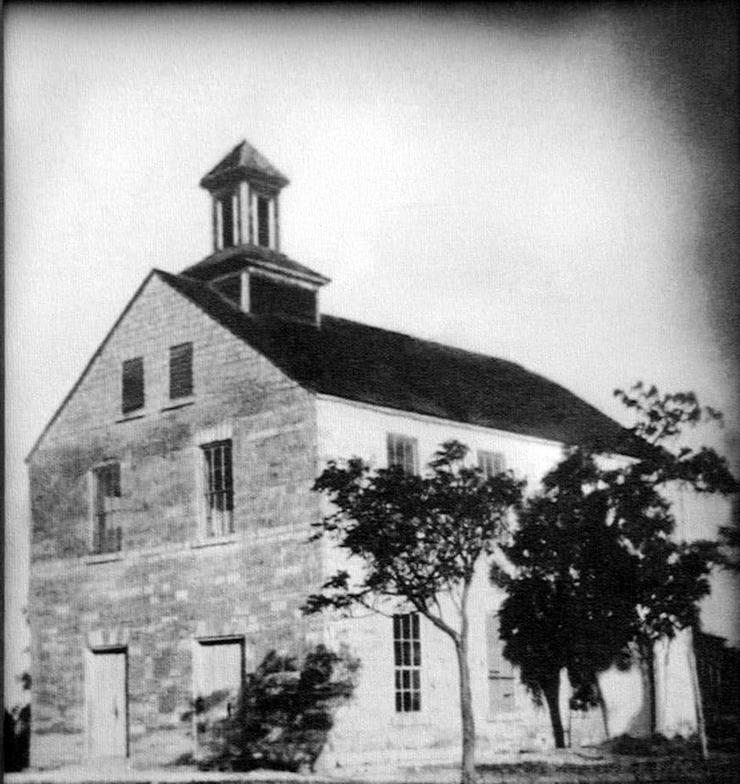
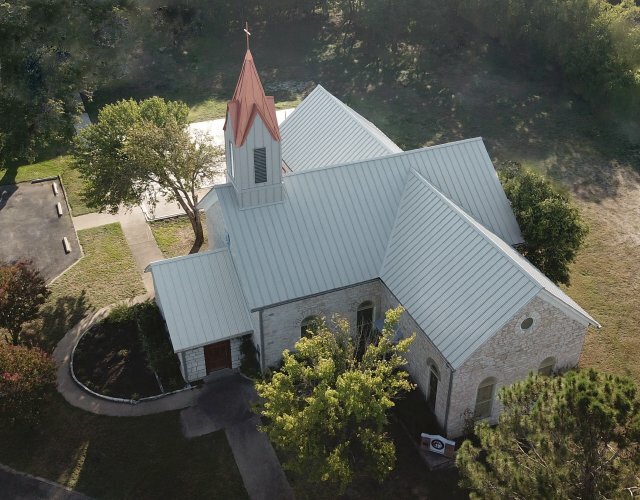
In 1870, Captain T. S. Snyder, a pioneer cattleman, and his son-in-law John T. Bryson donated two acres of land at the church's current location. A two-and-a-half-story building was constructed and served the community as a school, a Sunday school, and a place of worship. That small, original chapel still stands today.
Over the decades that followed, the congregation grew and the building evolved with it. In 1905, the two upper floors were removed, the choir and pulpit space was enlarged, and three memorial windows were installed. By 1916, two wings had been added to accommodate a growing Sunday school. In 1913, a tabernacle with a granite gravel floor and cedar-bough roof was erected on the property—the forerunner of what would eventually become the Fellowship Hall completed in 1993. In 1985, the United Methodist Church Commission on Archives recognized the congregation's historic significance, designating it United Methodist Historic Site No. 158.
The story of Cross Tracks Church in recent decades is one of growth, resilience, and deep roots in the Liberty Hill community.
In the 1990s, under the leadership of Pastor Sandy Carothers, a two-story fellowship hall was built beside the chapel. The nursery and kitchen occupied the ground floor alongside a large fellowship area, while the upper floor held offices and Sunday school rooms full of children and adults.
The year 2002 brought the founding of LHUMM, the church's first men's group, which grew into a community institution. The Wild Game Dinners, launched in 2008, drew people from across the region and raised funds for [Mike Bowles to complete this section]. Fifth Quarter gatherings after home football games became a beloved tradition for the whole community, and the church parking lot was enlarged and resurfaced to welcome the growing crowd.
The church's 150th anniversary—its Sesquicentennial—was celebrated in 2004 with a gathering that drew former pastors, music groups from area churches, and descendants of those who had donated the chapel's beloved stained glass windows. Bert and Louise Marcom, Louise Noble, and Rev. Lyndall Fletcher helped orchestrate a celebration that belonged to the whole community. The theme song, "Yesterday, Today and Tomorrow," was drawn from Hebrews 13:8.
Under the leadership of Pastor Randall Hilburn (2007–2014), the congregation continued to expand. A full-time Youth Minister was hired, and Sunday services grew from one to three, adding a contemporary service with a Praise Band alongside the traditional services. A Bell Choir was formed. Stephen Ministry, Grandies for Christ (a seniors group), and the United Methodist Ladies were all launched during this period.
In 2012, a new Worship Center was dedicated on May 20th, with Bishop Dorff delivering the sermon. The approximately 17,500-square-foot facility was built to accommodate a congregation that had outgrown its previous space. That same year, Operation Liberty Hill was founded, and Cross Tracks began a long tradition of serving those in need in the surrounding area.
A Mom's Day Out program, Sonshine Friends, launched in 2013 with six teachers and twelve students, supported generously by the community with donations of furniture, toys, and playground equipment. It would grow to serve sixty students with twelve teachers before closing in 2023, when staffing never fully recovered after the pandemic.
In 2016, with support from the Texas Methodist Foundation, the congregation developed the B.I.G. (Boundless Intentional Growth) Plan—a vision for spiritual, numerical, and financial growth focused upward, inward, and outward. As part of that renewal, on August 20, 2016, Liberty Hill United Methodist Church was renamed Cross Tracks Church, A United Methodist Community.
As Pastor Steve Fieldcamp explained at the time, the new name reflects both the church's geographic home and its deeper calling: to leave tracks of Jesus' love on the hearts of people in this place.
In 2018, a small committee including Pastor Fieldcamp crafted the mission statement that still guides the church today: Sharing God's Love with All by Word, Worship, and Witness. It was adopted by the Administrative Council on February 19, 2018.
Heritage Sunday 2017 offered another moment to look back. Gary Spivey—baptized at the church in 1957—and his daughter Kandice prepared and presented Heritage Tables filled with documents and artifacts from the church's long history.
On May 11, 2019, fire engulfed the fellowship hall. Five fire agencies responded and worked to save the historic chapel, but the fellowship hall was a total loss. Smoke traveled through air ducts into the worship center, damaging many items inside. The building had housed the church office, finance office, fellowship area, the Linus ministry, and Sonshine Friends Preschool.
A building committee formed quickly, and the congregation adapted. VBS was held just weeks later—without air conditioning or many modern comforts. Sonshine Friends relocated into the worship center, and the congregation learned to share the space they had.
In January 2020, a group of church members carefully refinished the chapel's original wooden doors. In February, generous donations from several families launched a full interior restoration of the historic chapel, guided by historic preservationists and the Texas Historical Commission.
Then, on March 11, 2020, the world changed. As COVID-19 shut down churches and schools across the country, Cross Tracks never actually closed—pivoting immediately to online worship with a small socially distanced support staff. Exterior restoration work on the chapel continued under Texas Historical Commission guidelines throughout the pandemic. The chapel received a new metal roof, copper cladding on the steeple slope, and a teak cross. Stained glass experts who evaluated the windows called the chapel a "museum of stained glass." The exterior coverings were removed and replaced with clear tempered glass, followed by fresh exterior paint.
On November 14, 2021, the church hosted Pioneer Days in partnership with the Williamson County Museum—a community celebration featuring a chuck wagon, old-fashioned games and handcrafts, a country store, and cake walk. Pastor Michele Lott arrived on horseback, dressed as a circuit rider. Several hundred community members and church families attended. Historian Gary Spivey shared stories of the area's deep past.
In March 2022, Boy Scout Troop #196 completed Connor Ford's Eagle Scout project: a music garden beside the chapel, featuring three outdoor instruments placed in memory of Louine Noble. Reagan McAnally's Eagle Scout project followed shortly after, adding handbuilt benches to the prayer garden beneath the large oak tree on the east side of campus.
In August 2023, the chapel interior restoration began in earnest. Foundation repairs were completed, new subfloors were installed, and a dropped ceiling was removed to reveal the original tin ceiling from around 1905. New electrical wiring and lighting were installed throughout—with one original fixture preserved in the chancel. New paint, hardwood flooring, and a tile narthex floor followed. The pews, purchased in 1937, remain in use today—fitted now with cushions and casters. Antique tables and chairs were added to the wings for small group gatherings and Bible study.
The restoration was celebrated on November 2, 2024, with an Open House and rededication. The first worship service back in the chapel was held on November 3, 2024, led by Reverend Doctor Brad King.